
What it is
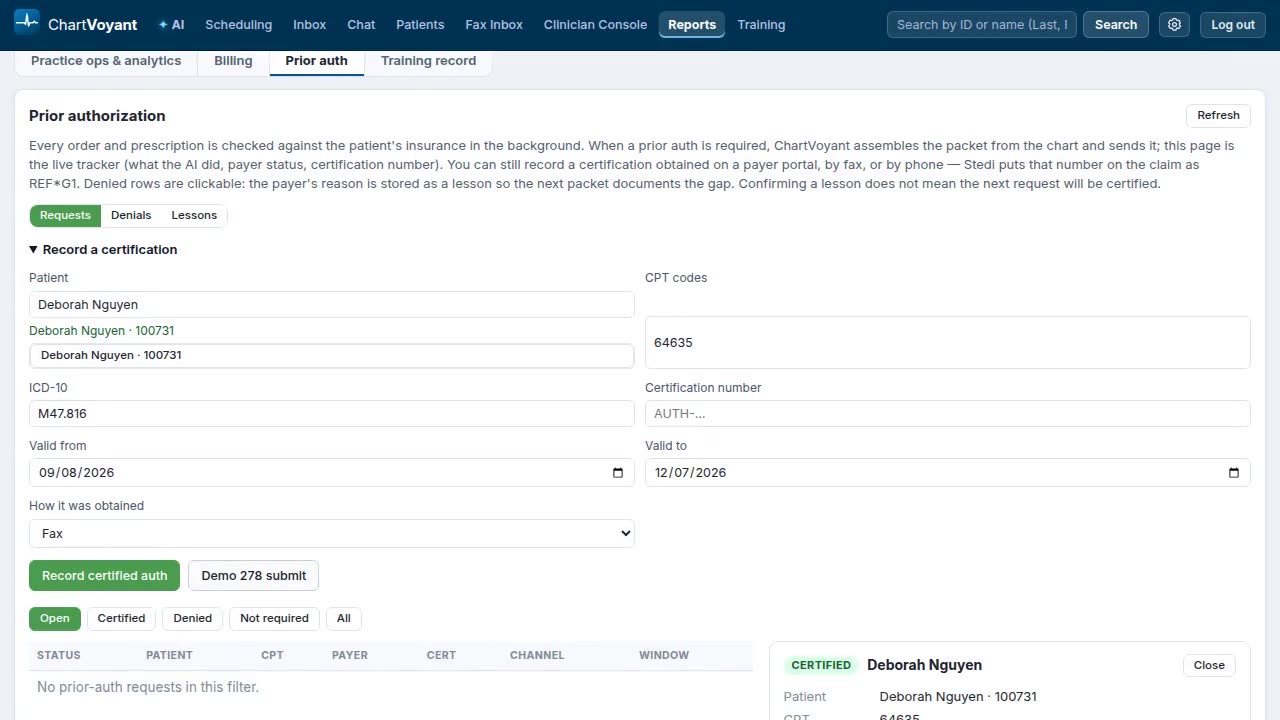
Pain clinics live on procedures, imaging, labs, and referrals. The failure mode is not “forgot to type the CPT.” It is the MRI that was mentioned, never requisitioned, never authorized, and never resulted — until the patient calls six weeks later. ChartVoyant keeps an order as a tracked object from the visit to the result.
On the clinic floor
Signing the visit commits the note and the non-medication orders together. Each order keeps a timeline: destination, coordinator, deadline, requisition, result, patient communication. Missing results surface without waiting on an inbound fax. Historical orders pick up tracking without being re-sent. Staff close of the coordination inbox item stays closed — a specific bug that used to reopen “Order follow-up: Lipid panel” on the next scan.
From the AI tab a clinician can place, cancel, re-address, and re-send an order, pick an in-network facility, and list what already went out. Network facilities rank imaging centers and labs from the practice roster plus original-Medicare FFS rules. Auto-route happens only when the chart has no preferred destination. Signing an order still takes a person.
What AI does, and what a clinician confirms
AI drafts the order from speech or from the AI tab. It can assemble a records packet and propose a destination. It cannot mark an order signed. Clinical Documents in the inbox are a signature queue: draft notes, unsigned orders (including ones an MA placed), and faxed forms asking for a signature. Labs, imaging, orders, and prescriptions are never auto-closed by the inbox assistant.
Non-Device CDS
Suggested orders are drafts. Facility ranking is administrative (in-network / FFS), not a clinical interpretation of an image. Results publish to the portal or hold because a clinician decided, with a practice default — not because a model judged the finding.
Where this sits vs bolted-on tools
A radiology portal, a paper requisition, and an EMR note that disagree are three sources of truth. ChartVoyant’s order loop is inside the chart, which is the only way a missing result can page the same inbox that already knows the visit. Imaging reports that arrive by fax are still filed to the chart; a plain-language summary restates the radiologist’s written report and never reads the pixels. A clinician acknowledges it.