What it is
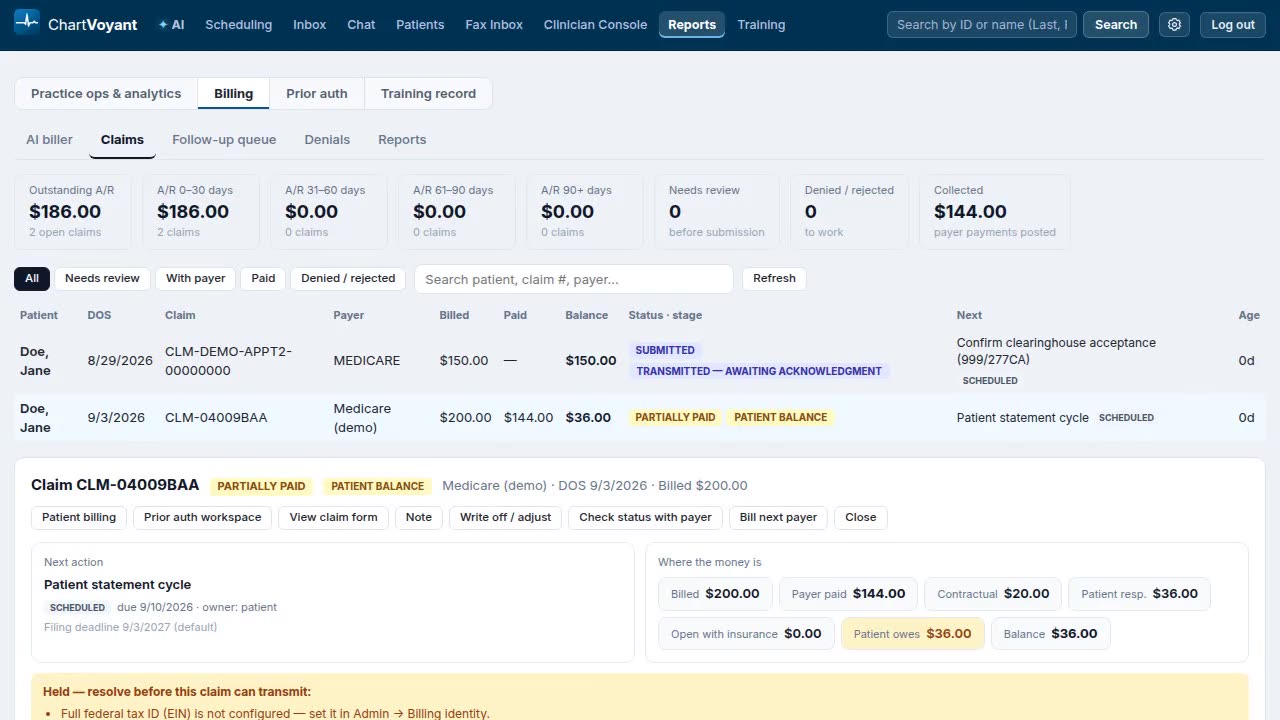
Revenue cycle for an independent pain clinic in Cleveland, Tennessee is Palmetto GBA (Medicare Part B, Jurisdiction JJ), BlueCross BlueShield of Tennessee, and TennCare — not Ohio’s MAC, not Medical Mutual. ChartVoyant’s billing workspace is A/R tiles, a claims table, and an open claim with ledger actions and where the money is. Checkout does not wait on the signature. Each office files its own 270/271, 837, and 835 enrollments under its TIN and group NPI; a claim for a payer that is not enrolled holds with a reason instead of failing at the clearinghouse.
On the clinic floor
The visit diagnosis carries into coding directly, which is where a whole class of medical-necessity denials comes from when it does not. Recommended E/M is shown with the decision-making elements, not as a number to rubber-stamp — expert coders disagree with each other on more than half of office encounters, which is the context every “AI coding accuracy” claim should be read in. Front-desk payments run on Square Terminal. Statements, remittances, and work items live on the same patient.
Ask ChartVoyant AI for a patient’s coverages, claims, remittances, statements, prior auths, and work items. It can check claim status, add a note, resubmit, send a statement, or hand the item to the AI biller — under the same confirmation rules as the Billing tab. Public demo billing pages are read-only; production is not.
What AI does, and what a person confirms
The AI biller works queues: denials, missing certs, eligibility mismatches. It drafts. It does not quietly mark a visit billed. A failed claim is a retry. Coding suggestions remain drafts. We do not claim superhuman E/M accuracy, because the literature does not support it.
Non-Device CDS
Coding suggestions are not diagnoses. They are billing drafts from an attested note. A clinician or biller with authority confirms. No autonomous claim goes out because a model was confident.
Where this sits vs bolted-on tools
A clearinghouse UI plus a coding vendor plus an EMR export is three reconciliations a week. ChartVoyant’s RCM never leaves the chart, which is also the only way a denial can open the note that should have prevented it. Built-in is not a slogan here; it is the architecture.